
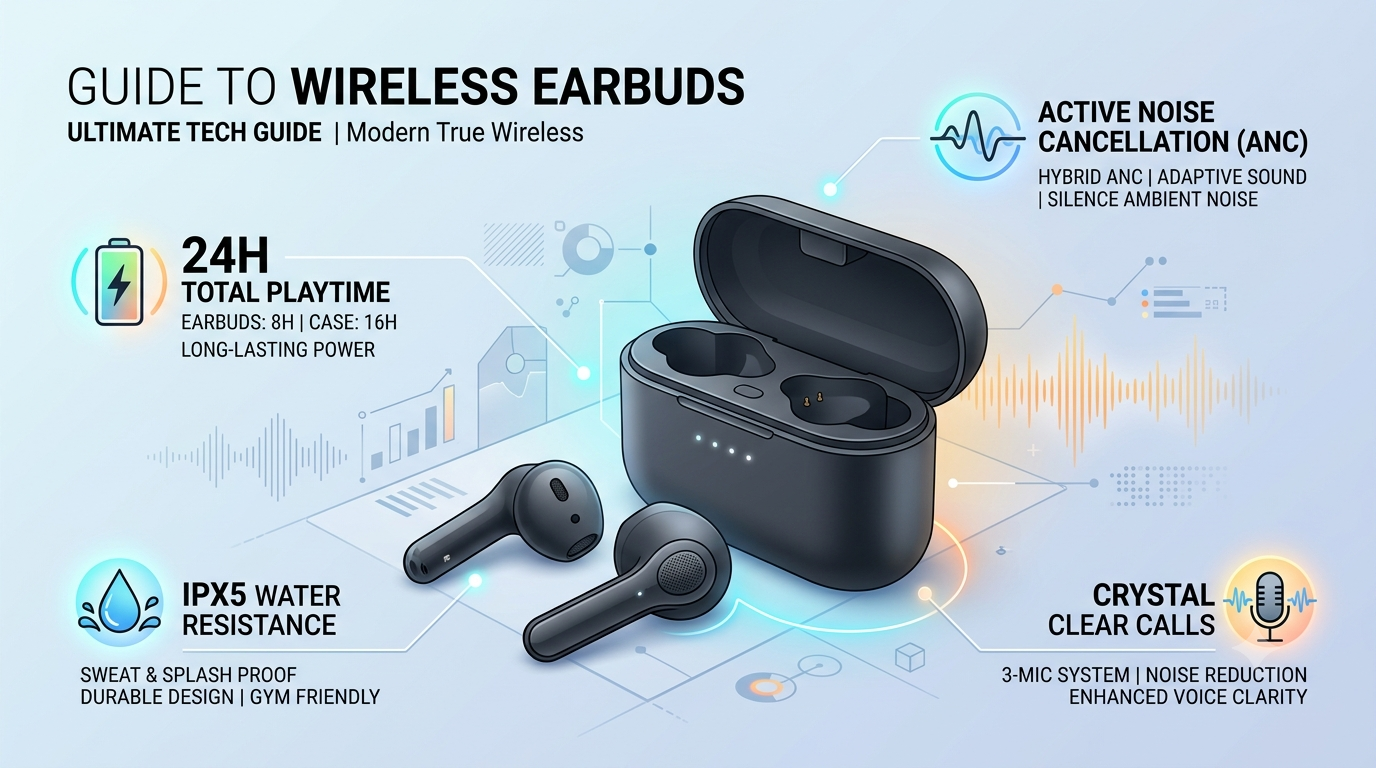
Every earbud box says the same things: "industry-leading ANC," "40 hours battery," "studio-quality sound." Most of that is technically true, but only under lab conditions you'll never actually experience. So how do you tell which specs actually matter for daily use, and which ones are just marketing? Here's a straight breakdown.
Battery Life — Trust It Less Than You Think
The number on the box is usually tested with ANC turned off, at moderate volume, on the ideal codec. In real life, expect to get about 70-80% of the advertised number in your first year of use, and less as the battery ages.
Also — the "ANC off" battery number printed on most boxes is basically fiction for anyone who actually commutes or travels, since you'll have ANC on most of the time. Always check the battery figure that's rated with ANC turned on — that's the honest number.
ANC (Noise Cancelling) — Depends Entirely on Your Life
ANC matters a lot if you commute, fly often, or work in a noisy office. It matters much less if you mostly listen to music at your desk or at home.
What actually makes ANC good isn't the dB number on the marketing page — it's how well the earbuds handle the noise you actually deal with: engine hum, AC/HVAC drone, and human voices, not lab test tones. Two pairs can both say "ANC" on the box and feel completely different in real use — premium models tend to cut low-frequency rumble cleanly, while budget ones just take the edge off and let a lot through.
Bonus tip: Also check transparency mode — this is what lets you hear an announcement or a shopkeeper without removing your earbuds. A bad transparency mode sounds robotic and makes conversations awkward. If you're often in public spaces, this feature deserves as much attention as ANC itself.
Fit and Comfort — More Important Than Most People Realize
An earbud that sounds amazing but keeps falling out after 40 minutes is genuinely unusable. Comfort depends on ear shape, so there's no universal "best fit" — but pay attention to:
Whether it stays secure during movement (walking, workouts, head turns)
Whether it starts feeling uncomfortable after an hour or two of continuous wear
Whether the seal stays consistent (a broken seal ruins both sound quality and ANC)
If possible, try before you buy, or check the return policy — this is one spec you genuinely can't judge from a spec sheet.
Codec and Latency — Only Matters for Specific Use Cases
This one's simple: if you mostly listen to music, codec and latency barely matter. If you game on your phone, watch a lot of video, or make frequent video calls, it matters a lot — laggy audio during a video call or a game is genuinely annoying.
If gaming or video is a priority, look for earbuds that support low-latency modes (often labeled "Game Mode" or similar) or newer Bluetooth versions, which generally reduce lag and improve connection stability in crowded wireless environments like airports or offices.
IP Rating (Water/Sweat Resistance)
Matters if you exercise, run, or sweat a lot with them in. Largely irrelevant if you mainly use them indoors or for commuting. Don't pay extra for a high IP rating if your use case doesn't call for it.
Call Quality — Often Overlooked
A lot of reviews focus entirely on music playback and skip call quality, but if you take calls with your earbuds regularly, this matters just as much. Look specifically for how the microphone handles background noise and wind — this is where even expensive earbuds sometimes disappoint.
Quick Summary — What to Prioritize Based on Your Use
Your main use | Prioritize this |
|---|---|
Commuting / flying often | Strong ANC + good transparency mode |
Gym / running | IP rating + secure fit |
Gaming / video calls | Low latency + good mic |
Desk / home listening | Sound quality + comfort for long wear |
Long workdays | Real-world battery life + fast charging case |
The Bottom Line
Don't buy earbuds based on a star rating and a flashy spec sheet. Match the earbuds to how and where you actually listen — a phone commuter with a noisy office and a gym-goer who runs outdoors have completely different "best" earbuds, even at the same price point. The most expensive or most hyped pair is rarely the right pick for everyone; the right pick is the one that nails the two or three things you personally care about.